

Lactate Has Been Getting a Bad Press for Decades. Here Is Why That Matters.
Ask most people what lactate is and you will get some version of the same answer: it is the burn, the reason your legs turn to concrete in the final ten minutes of a match, the thing that pools in your muscles when you push too hard and punishes you for it afterwards. It has a bad reputation, and that reputation is almost entirely undeserved.
The science on lactate has moved on considerably since the days when it was dismissed as a metabolic waste product, and what we now understand is that it is not an enemy to be avoided but rather a remarkable molecule, one that fuels your brain, your heart, and your working muscles simultaneously, and one that, when you learn to manage it properly, becomes one of the most powerful levers available for improving physical performance.
Whether you play football at any level, run on weekends, or simply want to understand why your fitness feels like it has hit a ceiling, the lactate threshold is probably the concept you have been missing.
What Lactate Actually Is
To understand the threshold, you first need to understand the molecule itself, and the first thing worth knowing is that lactate is not something that suddenly appears when exercise becomes intense.
Your body is producing lactate continuously, even at rest. Red blood cells produce it as a matter of routine because they lack the mitochondria needed for aerobic energy production. Skeletal muscle produces small amounts even during very light activity.
At rest, blood lactate concentrations typically sit somewhere between 0.5 and 2.0 mmol/L (millimoles per litre, the standard unit used to measure its concentration in blood), which is entirely normal and not a cause for concern.
Lactate is not a sign of dysfunction. It is a sign of normal metabolism.
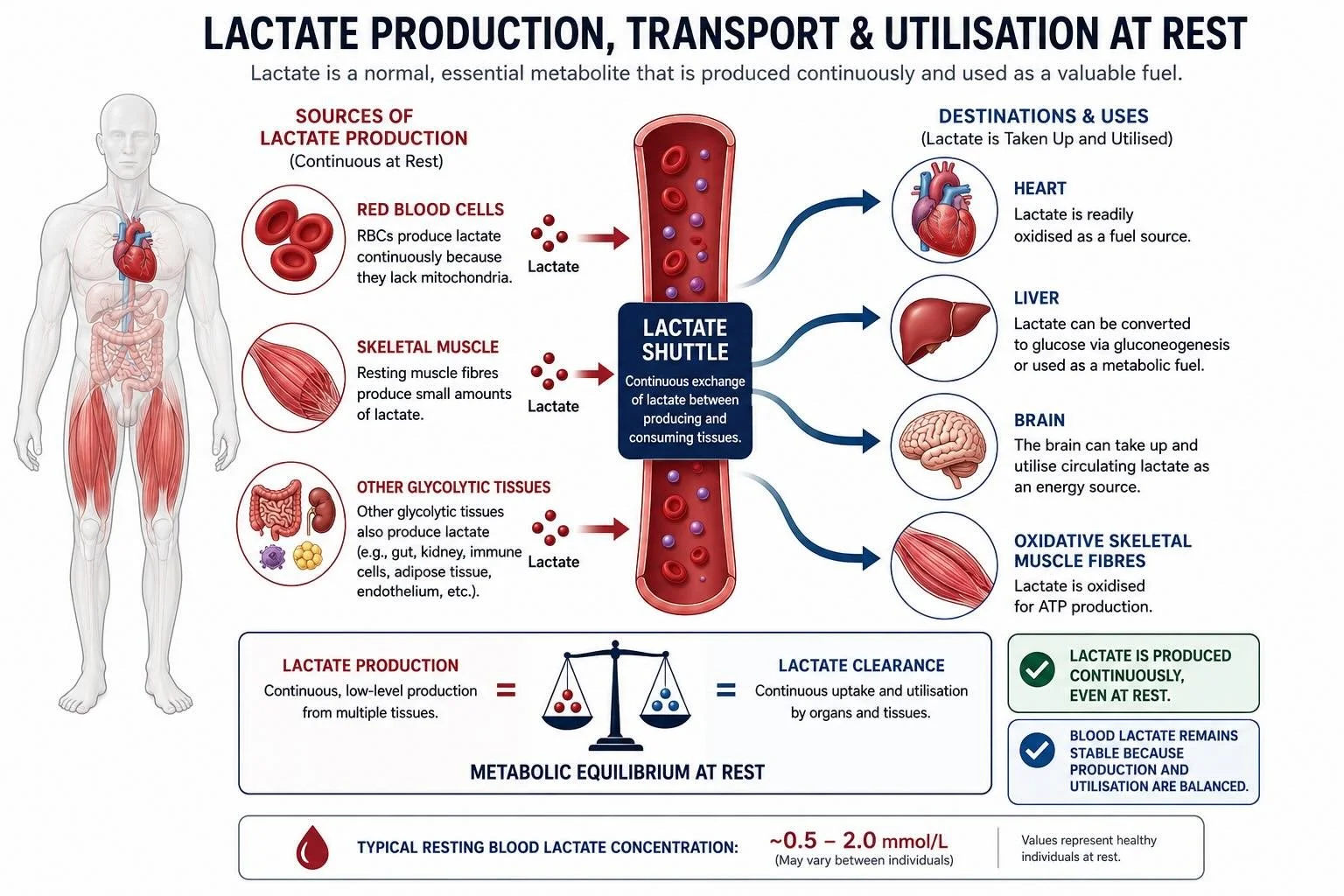
Lactate is produced and cleared continuously, even at rest. Blood lactate only rises when production outpaces clearance.
Lactate is produced and cleared continuously, even at rest, and blood lactate only rises when production outpaces clearance.
During exercise, the picture shifts in an important way.
As intensity increases, lactate production rises because the muscles are burning through carbohydrate faster to produce ATP, which stands for adenosine triphosphate and is simply the chemical currency your body uses to power every muscular contraction, every nerve signal, and every cellular process that keeps you moving.
At the same time, lactate clearance also increases, because the heart, the liver, the brain, and your oxidative muscle fibres are all actively using lactate as a fuel source. The key point is that blood lactate only begins to accumulate visibly when production starts to exceed the body's capacity to clear and utilise it. Everything before that point is a beautifully balanced system running exactly as intended.
To understand where lactate comes from in the first place, it helps to know a little about how carbohydrates are metabolised.
When glucose is broken down, it produces a compound called pyruvate. Pyruvate can then follow one of two paths:
It can enter the mitochondria for full aerobic energy production, yielding a large amount of ATP over time, or;
It can be converted to lactate by an enzyme called lactate dehydrogenase.
That conversion does not itself produce ATP, but it regenerates a critical molecule called NAD+, which is essential for the glycolytic process to keep running at high speed. In other words, the pyruvate-to-lactate step is not wasted energy; it is the mechanism that keeps the energy system turning over rapidly when demand is high.
Both pathways operate in parallel under most exercise conditions, which is another reason why the idea of exercise being either "aerobic" or "anaerobic" has always been an oversimplification.
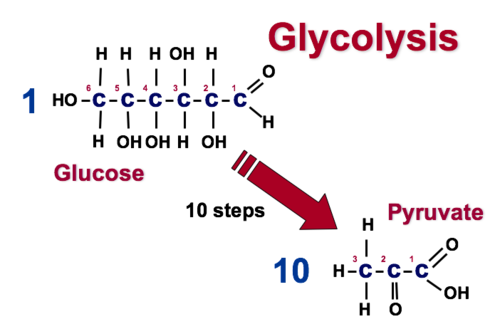
Glucose to pyruvate via glycolysis, essentially ‘carbohydrate breakdown’.
Pyruvate produced during carbohydrate breakdown can enter two pathways. Both operate simultaneously during exercise, and neither is wasteful.
What happens to the lactate once it is produced is where the story gets particularly interesting.
Rather than sitting in your muscles causing damage, it is shuttled out into the bloodstream and taken up by other tissues, including the liver, the heart, and the brain, where it is used as a fuel source in its own right.
This concept, known as the lactate shuttle, was developed through decades of research by Dr George Brooks at the University of California Berkeley, whose work has fundamentally reshaped how exercise physiologists understand energy metabolism.(1) The liver can also convert lactate back into glucose through a process called gluconeogenesis, contributing meaningfully to glucose availability during prolonged or high-intensity exercise, though the precise proportion varies considerably with exercise intensity, duration, and nutritional state.
Emerging evidence also suggests that lactate may have important signalling roles relevant to broader aspects of brain function, though this area of research is still developing and the full picture is not yet established.(2)
The burning sensation during intense exercise is also frequently misattributed to lactate, and it is worth correcting this directly.
Lactate is not the direct cause of the discomfort or the acidosis associated with hard effort. In fact, the conversion of pyruvate to lactate can actually consume hydrogen ions rather than generate them.
The fatigue and discomfort experienced during intense exercise are better understood as the result of a wider metabolic disturbance, involving hydrogen ion accumulation from other sources, inorganic phosphate build-up, potassium shifts across cell membranes, impaired calcium handling within muscle fibres, and central fatigue signals from the nervous system, among other factors.
The detail matters because athletes who train to manage lactate are not training to avoid discomfort; they are training to sustain a higher workload before that broader metabolic disruption takes hold.
The Lactate Threshold: What It Is and Why It Matters
At low to moderate exercise intensities, lactate production and clearance remain broadly in balance, and blood lactate concentrations stay relatively flat.
As intensity rises, there comes a point where production begins to meaningfully outpace clearance, where the curve stops being flat and starts to climb. That inflection point is the lactate threshold, and it is one of the most meaningful markers of aerobic fitness available.
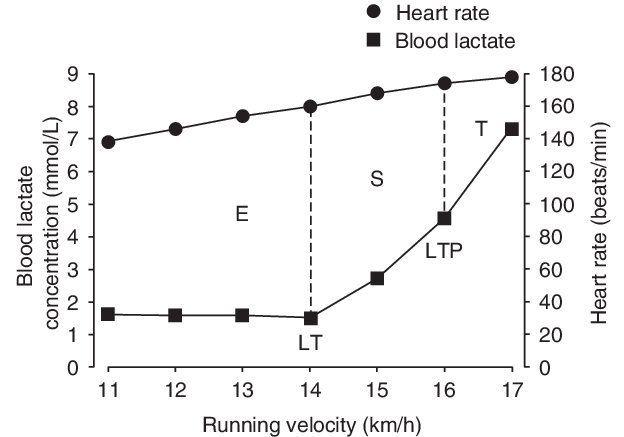
Taken from Midgley and colleagues (2007). Blood lactate and heart rate responses of a competitive club runner during an incremental exercise test. Zones are indicated by running velocities and HR associated with the lactate threshold (LT) and the lactate turnpoint (LTP). Easy (E), steady (S) and tempo (T).
As exercise intensity increases, blood lactate eventually begins to accumulate faster than it can be cleared. Training shifts this threshold to the right, meaning you can work harder before it occurs.
Why does it matter so much?
Because the lactate threshold tells you not just how hard your body can work, but how hard it can sustain working over time, and this distinction is what separates genuinely fit athletes from those who can only perform in short bursts.
Two athletes might have identical VO₂max values (max rate at which the body can consume and utilise oxygen and is commonly used as the headline measure of aerobic fitness), yet perform very differently in a match or a race if one of them has a significantly higher lactate threshold. The athlete whose threshold sits at a higher percentage of their maximum can run faster, work harder, and maintain that output for longer before the physiological wheels begin to come off.
For footballers in particular, this is far from a trivial consideration.
Elite players cover somewhere between 10-12 km per match, sustaining a mean intensity of approximately 70-75% of their maximum oxygen uptake.(3)
That demands a highly developed aerobic engine not just for the high-speed running and sprinting, but for the recovery between those efforts, which is the ability to bring heart rate and metabolic stress back down quickly enough to be ready for the next burst of acceleration.
Research consistently shows that a player's lactate threshold reflects their training status and plays a meaningful role in determining their capacity to sustain performance across 90 minutes, and that players in higher divisions tend to reach the threshold at faster running speeds than those in lower ones.(4)
The seasonal pattern of lactate threshold development is also well documented and worth understanding if you are involved with a football club at any level.
Studies tracking professional youth players across a full season have shown that running velocity at the lactate threshold improves significantly during the pre-season preparation period, with the most meaningful gains occurring between the start of pre-season and the early weeks of competitive fixtures, before largely plateauing for the remainder of the campaign.(5)
The explanation for those pre-season improvements appears to be less about the threshold shifting in a relative sense and more about improvements in overall aerobic capacity, with VO₂max and running economy likely both contributing to the observed gains.
This matters because it suggests that pre-season training needs to develop the whole aerobic system rather than targeting the threshold in isolation.
A Note for Academy Players and Their Parents
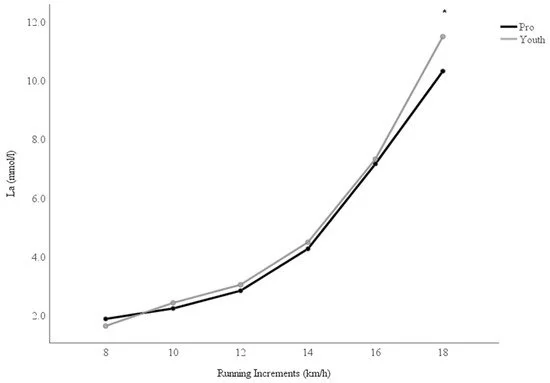
Lactate curve comparing youth (n = 25) and pro (n = 36) athletes completing a test. Taken from Michaelides and Parpa (2025)
Despite often having higher VO₂max values, elite youth players tend to accumulate lactate more rapidly at very high running intensities compared to senior professionals.
There is a finding in the research literature that is genuinely counterintuitive and worth understanding if you have a young player in your household or work within an academy environment.
Research comparing elite under-17 players with senior professionals in the same club structure found that the younger players actually had higher VO₂max values, which sounds as though the young athletes should be fitter, yet the senior professionals consistently outperformed them on incremental exercise testing and demonstrated better running economy.(6)
The difference showed up clearly in lactate data, with youth players accumulating lactate more rapidly at very high running intensities, suggesting that despite a high aerobic ceiling, they had not yet developed the metabolic efficiency to sustain elite-level output across the full intensity range.
It is important to note that this was a specific study with a selected group of players rather than a universal rule of academy development, but the underlying principle is well supported more broadly: VO₂max alone is not sufficient to predict performance, and the development of lactate threshold and running economy alongside maximal aerobic power is a meaningful part of what characterises the progression from talented young athlete to high-performing professional.
The Measurement Problem Worth Knowing About
There is a complication surrounding lactate threshold testing that does not receive enough attention in fitness circles, and it is worth understanding if you ever have access to formal lactate profiling.
The lactate threshold is not a single, universally agreed measurement but rather a concept, and there are multiple different mathematical methods used to identify where exactly on the lactate curve the threshold sits.
Four of the most commonly used approaches are visual inspection by an experienced practitioner, the Dmax method (which identifies the point on the lactate curve that is furthest from the straight line connecting the lowest and highest measured values), the modified Dmax method (which uses the first meaningful rise in lactate rather than the lowest measured value as its starting anchor), and the log-log transformation (a mathematical technique that plots both lactate and exercise intensity on logarithmic scales to identify the inflection point).
A further approach uses a fixed blood lactate concentration of 4 mmol/L as the threshold marker, sometimes referred to as the onset of blood lactate accumulation, or OBLA.
These methods do not always agree with each other, and research comparing them directly in professional soccer players has found that they should not be used interchangeably, particularly when it comes to prescribing specific running speeds for training.(7)
The log-log method tends to identify the threshold at a lower running speed than the visual inspection and Dmax approaches, sometimes by a meaningful margin, which has direct practical implications for anyone using threshold data to set training intensities.
If a practitioner assesses you using one method and then retests you months later using a different one, the numbers are not directly comparable regardless of what direction they appear to move. Consistency of method across assessments matters considerably, and it is entirely reasonable to ask which approach is being used when you undergo lactate testing.
What This Means in Practice
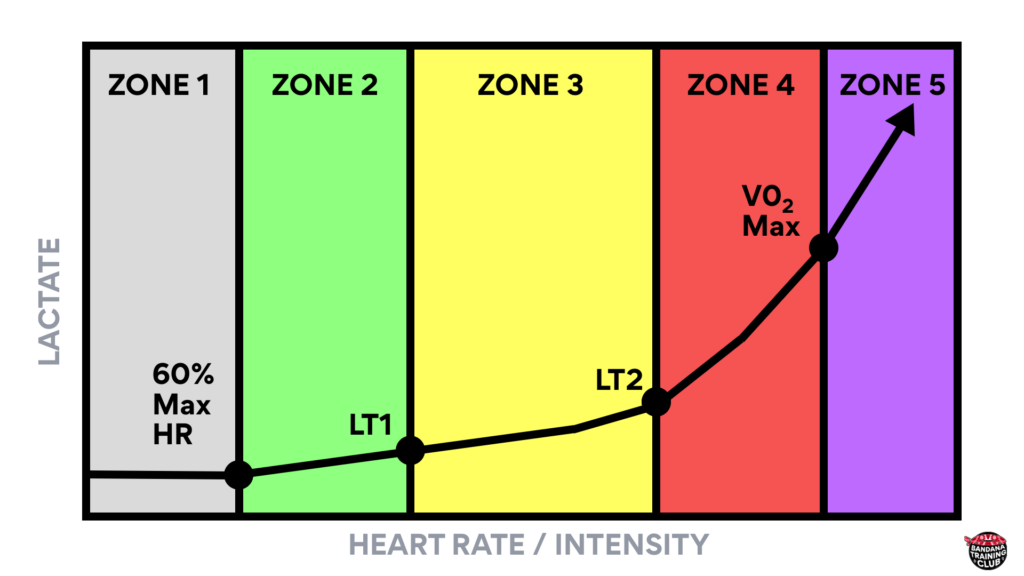
5-zone training model, highlight LT1 = aerobic threshold, and LT2 = anaerobic threshold, as well as VO2Max for reference of intensity. Image taken from Bandana Training Club.
Threshold training sits in the zone that is genuinely challenging but sustainable, harder than a comfortable jog but not a flat-out effort.
For the recreational footballer, the weekend runner, or the fitness-focused individual wondering what to actually do with this information, the practical message is relatively clean even if the underlying science is layered.
Training that pushes you into and around your threshold, which in practice means sustained efforts at an intensity that is challenging but manageable rather than a flat-out sprint, is enormously effective at improving aerobic capacity in a time-efficient way.
This kind of work trains your body to manage and utilise lactate more effectively by improving lactate transport across cell membranes, enhancing the ability of the heart and oxidative muscle fibres to oxidise it as fuel, increasing mitochondrial density, improving running economy, and ultimately allowing you to sustain a higher workload before blood lactate begins to accumulate at a rate that limits performance.
Over weeks and months, the threshold shifts to the right, meaning the intensity at which your body starts to struggle becomes progressively higher, and you can run faster, last longer, and recover more quickly between efforts.
Nutrition plays a meaningful and frequently underappreciated role in this process. Carbohydrate availability directly influences lactate dynamics, since well-fuelled muscles have more substrate to work with, and the quality of threshold training sessions depends substantially on arriving adequately fuelled.
There is also evidence that dietary patterns affect how the threshold responds to training over time, and in clinical practice this is one of the areas where individual assessment and guidance tends to make a tangible difference to the rate at which an athlete develops. Generic advice from online sources rarely captures the specificity required to get this right.
The lactate threshold is not a mysterious metric reserved for elite athletes in laboratory conditions.
It is a genuinely accessible window into your fitness, and understanding it even in broad strokes puts you in a better position to train with purpose, interpret your own performance, and make informed decisions about how to develop as an athlete.
Lactate is not the enemy. It never was.
Ian Perkins is a SENR registered Sports Nutritionist and HCPC registered Dietitian working with professional athletes and performance-focused individuals across the UK. If you are interested in optimising your nutrition to support training adaptation and performance, get in touch here.
References
Brooks GA. The science and translation of lactate shuttle theory. Cell Metabolism. 2018;27(4):757–785.van Hall G, Strømstad M, Rasmussen P, et al. Blood lactate is an important energy source for the human brain. Journal of Cerebral Blood Flow and Metabolism. 2009;29(6):1121–1129.Bangsbo J, Mohr M, Krustrup P. Physical and metabolic demands of training and match-play in the elite football player. Journal of Sports Sciences. 2006;24(7):665–674.Ziogas GG, Patras KN, Stergiou N, Georgoulis AD. Velocity at lactate threshold and running economy must also be considered along with maximal oxygen uptake when testing elite soccer players during preseason. Journal of Strength and Conditioning Research. 2011;25(2):414–419.McMillan K, Helgerud J, Grant SJ, et al. Lactate threshold responses to a season of professional British youth soccer. British Journal of Sports Medicine. 2005;39(7):432–436.Michaelides M, Parpa K. Lactate profiling and the agreement among various lactate threshold methods in professional and youth soccer players. Applied Sciences. 2025;15(3):1399.Cerda-Kohler H, Burgos-Jara C, Ramírez-Campillo R, et al. Analysis of agreement between four lactate threshold measurement methods in professional soccer players. Journal of Strength and Conditioning Research. 2016;30(10):2864–2870.